AI literacy in the workplace: what employees need to know and do
An employee asks an AI tool to draft a reply to a customer. The wording is clear and the tone is right, but the message includes a discount nobody has approved. Will the employee spot it before sending the email?

AI literacy in the workplace means understanding what artificial intelligence (AI) can do, choosing suitable tasks, protecting information and assessing the results. Employees need to know which work they can entrust to a tool, what they must check themselves and when a colleague or specialist needs to make the decision.
Is it mandatory? Yes, where a company uses AI systems at work, including a conversational assistant. The obligation under Article 4 of the EU AI Act has applied since 2 February 2025. The amended provision, in force since 27 July 2026, does not require companies to guarantee a specific level of AI literacy for each individual; a special certificate is not required [1, 6]. Read more about the AI Act requirements.

What is AI literacy?
AI literacy encompasses the knowledge, practical skills and understanding needed to use AI systems responsibly and assess the possible consequences. In a company, it starts with straightforward questions: which system are we using, for what purpose, what are its limitations and who is responsible for the final result [1]?
A good prompt helps produce a better draft. Employees still need to recognise when an answer sounds convincing but has no evidence behind it. Otherwise, an error in a chat window can find its way into a customer email or a management decision.
There is no need to learn programming or the mathematics behind the model. Most specialists will need other skills in their daily work: selecting appropriate data, recognising a faulty assumption and checking a piece of writing or a calculation. Technical teams will need deeper knowledge suited to their responsibilities.
This article focuses mainly on generative AI used to create content and process information. AI literacy also matters when employees rely on recommendations or assessments from other types of AI systems to make decisions.
What employees need to understand about AI responses
A well-written response can be wrong. Generative AI can invent a fact, a passage from a document or a source and present it confidently. These errors are often called hallucinations. The NIST generative AI risk profile also discusses bias and excessive reliance on a system’s output [2].
Employees need to distinguish between information they supplied, information the tool may have retrieved from a connected source and claims that appear without a clear basis. If the tool has not been given the company’s returns policy, the terms it generates should not become a promise to a customer.
It is also worth checking whether information is current. A price, legal provision or service feature mentioned in a response may no longer be accurate. When using AI for research, employees still need to assess the source itself: its date, its author and whether it actually supports the conclusion.
Simply asking the same tool to “check again” does not provide independent verification. When a decision depends on a fact, it needs a reliable original source, a calculation that can be reproduced or a review by someone with the relevant expertise.
How to choose a suitable task for AI
For an initial trial, choose a small task whose result the employee knows how to check. This could be drafting a public product description, summarising a training version of a document or comparing the structure of several previously approved proposals. In each case, agree on how quality will be assessed.
Complexity is not the only consideration. The consequences of an error matter too. A draft for an internal brainstorming session and a commitment sent to a customer require different levels of care. Employees should know which tasks allow AI output to be used only as supporting material.
If someone lacks the knowledge to check an answer, they should assess the task with a specialist in that field. This is particularly relevant when preparing legal opinions, assessing people or making financial or safety-related decisions. The company needs to establish who reviews these cases and when AI use is not permitted.
Sometimes a more suitable method is already available. A checked spreadsheet formula may be enough for a straightforward calculation. For transferring standardised data between systems, rules-based automation may be worth considering. AI literacy helps people choose a method that fits the task.
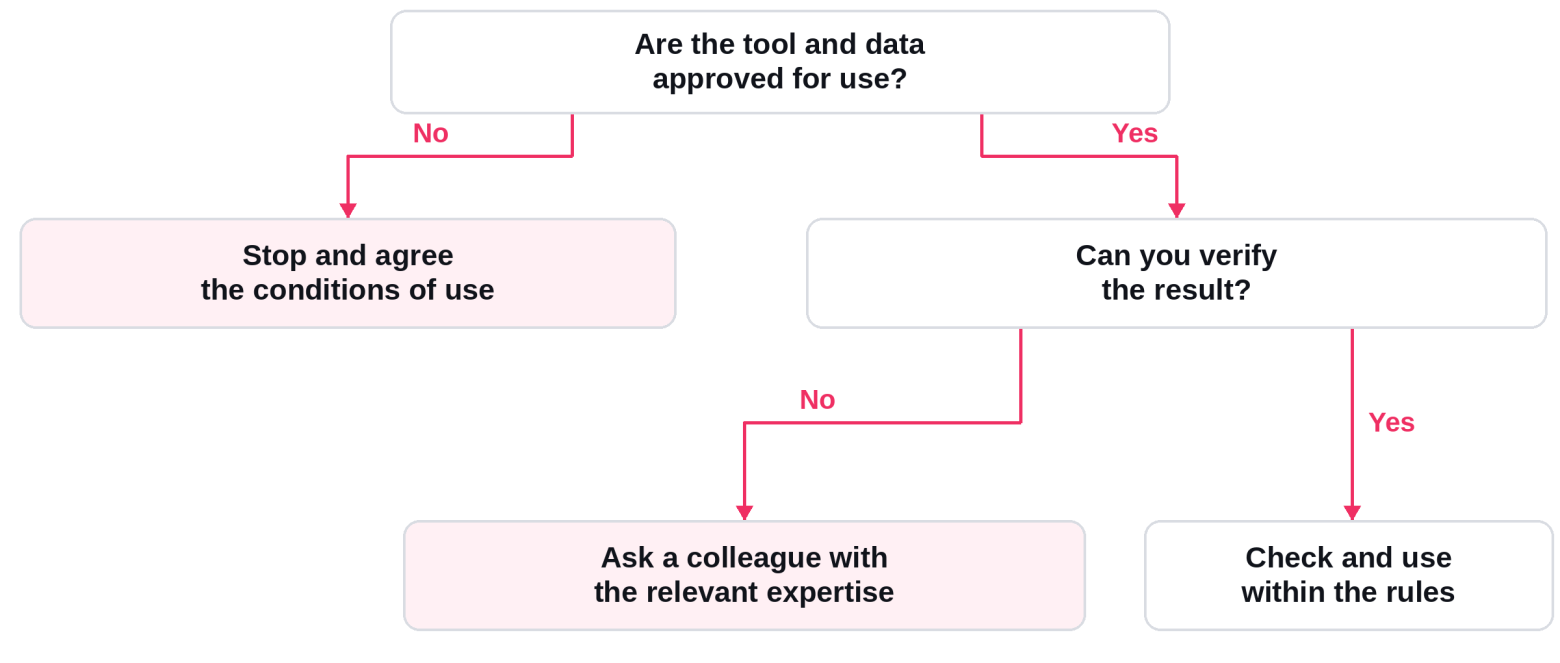
What data can employees share with an AI tool?
The first question is whether the company permits the chosen tool and account to be used for the task. A personal account should not automatically become a place to upload company documents simply because an employee finds it convenient. The people responsible within the company need to assess whether the tool is suitable for the data involved.
Before sharing material, check whether it contains customer contact details, employee data, contracts, non-public pricing or trade secrets. Then consider whether all of that information is actually needed. For a training exercise, it is often possible to create a fictional example that preserves the logic of the task.
Removing a name may not be enough. A person can sometimes be identified through their role, the circumstances of a project or other information left in the document. The GDPR distinguishes anonymous information from pseudonymised data: if a person can still be identified, data protection requirements remain relevant [3].
A licence name or a paid account does not answer every security question. The assessment needs to cover the specific service’s terms, settings, access permissions and the company’s obligations. Employees should not have to repeat this analysis themselves every time. They need clear guidance on which tools they can use and what information they can share.
If sensitive information has already been shared with an unsuitable tool, stop and notify the responsible colleague under the company’s incident procedure. Deleting the conversation and considering the matter closed is not an adequate response plan.
How to give clear instructions
A good prompt starts with a clear objective. Tell the tool who the output is for, which sources to use, what format is expected and which boundaries it must respect. A long prompt is not automatically better: what matters is providing the information the task requires.
Instead of “write a reply to the customer”, an employee could ask:
“Draft a short reply using the sample customer enquiry and the customer service rules provided. Do not offer discounts or promise an unconfirmed delivery date. If information is missing, flag what I need to clarify with a colleague.”
This wording makes the boundaries explicit. The employee must still check that the tool has respected them. An instruction to use only the supplied material describes the intended approach; it does not guarantee that the response will contain no additional claims.
More complex tasks can be broken into stages. First ask the tool to extract information from a source, check it and then prepare the final text. This makes it easier to see where an error arose and prevent it from carrying through to the next stage.
How to check AI-generated output
The review needs to fit the task. When checking a document summary, compare the main conclusions with the original: has an exception been omitted, have the parties been confused or has a deadline been invented? For customer-facing text, also check commitments, service terms and tone.
Calculations need more than a convincing explanation. Employees must be able to reproduce the result using an appropriate calculation tool and understand the data behind it. Check the reporting period, units, filters, missing values and duplicate records. A total that looks right is not evidence that the calculation is correct.
Suppose a training spreadsheet contains several months of orders, but the task is to report on a single month. Even adding every row correctly would produce the wrong answer without the relevant date filter. Verification therefore starts with whether the work answers the question that was actually asked. Employees should be able to explain which records they included and why.
Open the links. A publication title or URL in a response does not show that the source exists or says what the response claims. For a legal or technical fact, look for the current official document rather than relying solely on someone else’s summary.
Watch for unsupported assumptions about people too. Does an employee assessment attribute qualities that the supplied information does not support? Does a customer description contain stereotypes? These situations require a reviewer who understands both the content and the consequences of the decision.
When to stop and ask for help
Employees should know whom to contact when permission to use data is unclear, an error is found or a tool behaves unexpectedly. A colleague familiar with the terms may review a customer proposal, while a question about data use should go to the person responsible for it.
When an AI tool can act in other systems
Extra care is needed when an AI system can do more than draft text and has permission to take action in other systems. Before approving an email, a record change or another action, employees need to understand what will happen, who it affects and what information will be shared.
Employee vigilance complements technical access controls and safeguards on actions. It does not replace them, so the technical team must also take responsibility for system permissions and protections.
When giving a tool access to another system, employees need a clear explanation of the scope: can it only read information, or can it also change records and send messages? “Prepare an email” should not be treated as automatic permission to send it. Discuss these boundaries before the first practical trial and align them with the technical permissions.
Teams using Claude can explore this topic through the WyrdIT Academy guide “What are Claude Connectors?”. It covers connecting systems and reviewing the permissions granted. The guide introduces a specific tool; the company’s permissions and data use rules still need to be agreed separately.
When a tool connects to company systems, AI integrations and agents need to be assessed alongside access permissions and action approvals.
Instructions in external files and websites
External files or websites may contain instructions intended to influence a tool’s behaviour. OWASP describes this as a form of prompt injection: the system may mistakenly interpret external content as an instruction [4]. Employees need to understand the practical boundary: an unexpected request to share data or change the workflow must be checked, not approved automatically.
What AI literacy looks like in practice
Imagine a customer service team working with a fictional enquiry about a delayed order as a training exercise. The tool receives only the rules needed for that task. They contain neither a confirmed new delivery date nor permission to offer a discount. This is an illustrative example, not a WyrdIT client story.
The generated draft promises delivery the next day. The employee compares it with the source and notices that the promise has no basis. They remove the date, flag the missing information and contact a colleague who can confirm the order status. Only after receiving an answer do they finalise the email.
Here, AI literacy shows up in skills that can be assessed: selecting appropriate data, explaining the task, spotting an unsupported promise and knowing who makes the final decision. A fluent first draft would not, on its own, be an adequate result.
This task can also be used to assess understanding. Observe whether the employee finds the error independently and can explain why it cannot be left in the reply. Selecting the correct answer in a test does not always demonstrate that ability.
For another practical example, see the WyrdIT Academy guide to preparing business proposals with Claude using your company’s rules. It can support a discussion about the context a tool needs and how to review a proposal before sending it. You need to sign in to view some of the prompts in the guide.
Do all employees need the same knowledge?
People using AI on a company’s behalf need a common foundation: understanding its limitations, following data rules, checking the output and knowing their responsibilities. Beyond that, tailor the content to their work and the possible consequences of an error [1].
| Team | Practical learning priorities |
|---|---|
| Customer service and sales | Approved terms, accurate commitments, customer data and handing a response over to a colleague |
| Marketing and administration | Facts, sources, the purpose of the text, document accuracy and publication procedures |
| HR specialists | Personal data, unsupported assumptions, bias and reviewing decisions |
| Managers | Permitted use cases, responsibilities, controls and evaluating results |
| IT and data specialists | Access permissions, integrations, system limitations, monitoring and technical risk management |
These are suggested learning priorities, not a universal programme. One team may need more practice with documents; another may need to recognise situations where AI should not be used. A job title alone does not establish what someone already knows or what preparation they need.
What the company needs to put in place
The European Commission suggests starting with a general understanding of AI across the organisation, the company’s role as a provider or deployer, system risks, and employees’ preparation and context of use [1].
Employees should not have to guess whether they can upload a document to a particular tool. Prepare a short AI use policy: what is permitted, which data must not be shared, who reviews the output and whom to notify about a problem. Include examples from the team’s work.
Managers need to discuss how AI is actually used, including uncomfortable questions: where people copy documents, who checks the results and what happens when an error is found. Reporting arrangements need to work in practice. If employees do not know whom to contact, they do not have a usable route to support.
Learning can start with one task using material that is safe to share. If the team needs support, one option is practical AI training for your team.
Employees try the task, compare results and discuss mistakes. After an agreed period of practice, assess whether they have applied the skill at work and what got in the way. Attendance and satisfaction with a session should be assessed separately from the ability to complete a task independently.
For the assessment, choose a new example of similar difficulty so the participant cannot simply repeat an answer from memory. Observe whether they follow data rules, identify unsupported claims and know when to refer a question to a colleague. Include fact-checking and corrections when measuring time spent. If the result fails to meet the quality criteria, producing it faster does not establish that the method is suitable.
Ask what is getting in the way. An employee may know how to do the task but lack access. Two company instructions may contradict each other. In that case, fix the working conditions first.
Short internal discussions, a collection of checked examples and support for new employees can help sustain learning. Review knowledge and rules as tools, permissions and purposes change. The European Commission’s repository presents different organisational approaches to learning; copying them does not automatically create a presumption of legal compliance [5].
To explore how work is organised, you can use the WyrdIT Academy webinar “From AI tools to working business processes”.
Is AI literacy mandatory? What Article 4 of the AI Act requires
The obligation under Article 4 of the AI Act has applied since 2 February 2025. Regulation (EU) 2026/1744 was published on 24 July 2026 and entered into force on 27 July.
Under the amended provision, providers and deployers of AI systems must take measures to support the development of AI literacy among their staff and others using systems on their behalf. Knowledge, experience, preparation and the context of use are taken into account. Companies are not required to guarantee a specific level of AI literacy for every individual [1, 6].
The provision does not prescribe one mandatory course or a set number of training hours for all companies. The European Commission also explains that a special certificate is not required [1]. A training certificate may record participation, but it does not demonstrate full compliance.
The practical task assessment suggested in this article is a recommendation for developing skills. It is not presented as a legally required examination for all employees. A company’s specific obligations need to be assessed in light of its role, systems and activities.
The European Commission explains that the obligation also applies to a company whose employees use a conversational assistant to write or translate text. Employees need to be informed about specific risks, such as hallucinations [1].
The supervision and enforcement rules have applied since 2 August 2026. They are implemented by national market surveillance authorities rather than the European Commission’s AI Office [1].
Deployers of high-risk AI systems retain a separate obligation under Article 26 of the AI Act to ensure that staff are trained to provide human oversight [1].
Frequently asked questions about AI literacy
These answers draw on the European Commission’s explanations [1].
Is AI literacy mandatory if employees only use ChatGPT or another conversational assistant?
Yes, the obligation also applies to this use. The European Commission says employees should be informed about specific risks, such as hallucinations.
Is an AI literacy certificate or exam required?
No, Article 4 does not require a certificate or an exam. The European Commission explains that organisations can keep internal records of their measures.
Who checks compliance with Article 4, and from when?
This falls within the remit of national market surveillance authorities. The supervision and enforcement rules have applied since 2 August 2026.
Do all employees need the same training?
No, learning needs to reflect employees’ knowledge, experience and circumstances of AI use. Practical tasks may differ according to roles and responsibilities.
How can a company document its AI literacy measures?
It can keep an internal record of training, guidance and other learning initiatives. No special certificate is required for this.
Where to start with your team
Choose one task employees already perform, or plan to perform, with AI. Agree on what information they can use, how they will check the result and when they should ask for help. Then observe whether they can carry out these steps independently.
AI literacy in the workplace becomes visible through specific decisions: withholding unsuitable data, spotting an error, checking a source or stopping an unclear action. That requires both employee skills and clear working arrangements.
Using Claude and want to put these principles into practice with your team? Explore WyrdIT’s Claude training for companies.
To get started independently, visit WyrdIT Academy, a free library of practical Claude guides.
Sources
The practical scenarios are illustrative.
[1] AI Literacy Questions and Answers. European Commission, DG CONNECT. Updated 20 October 2026.
[2] Artificial Intelligence Risk Management Framework Generative Artificial Intelligence Profile. NIST AI 600-1. Published 26 July 2024.
[3] General Data Protection Regulation (EU) 2016/679. European Parliament and Council. 27 April 2016. References: Recital 26 and Article 4(5).
[4] LLM01 2025 Prompt Injection. OWASP Gen AI Security Project. 2025 edition; no separate page update date is stated.
[5] Repository of AI literacy practices. European Commission, DG CONNECT. Updated 27 July 2026.
[6] Regulation (EU) 2026/1744. European Parliament and Council. Published 24 July 2026; entered into force 27 July 2026. Reference: the amended version of Article 4 of the AI Act.
Primary source for the definition: Regulation (EU) 2024/1689, Article 3(56).